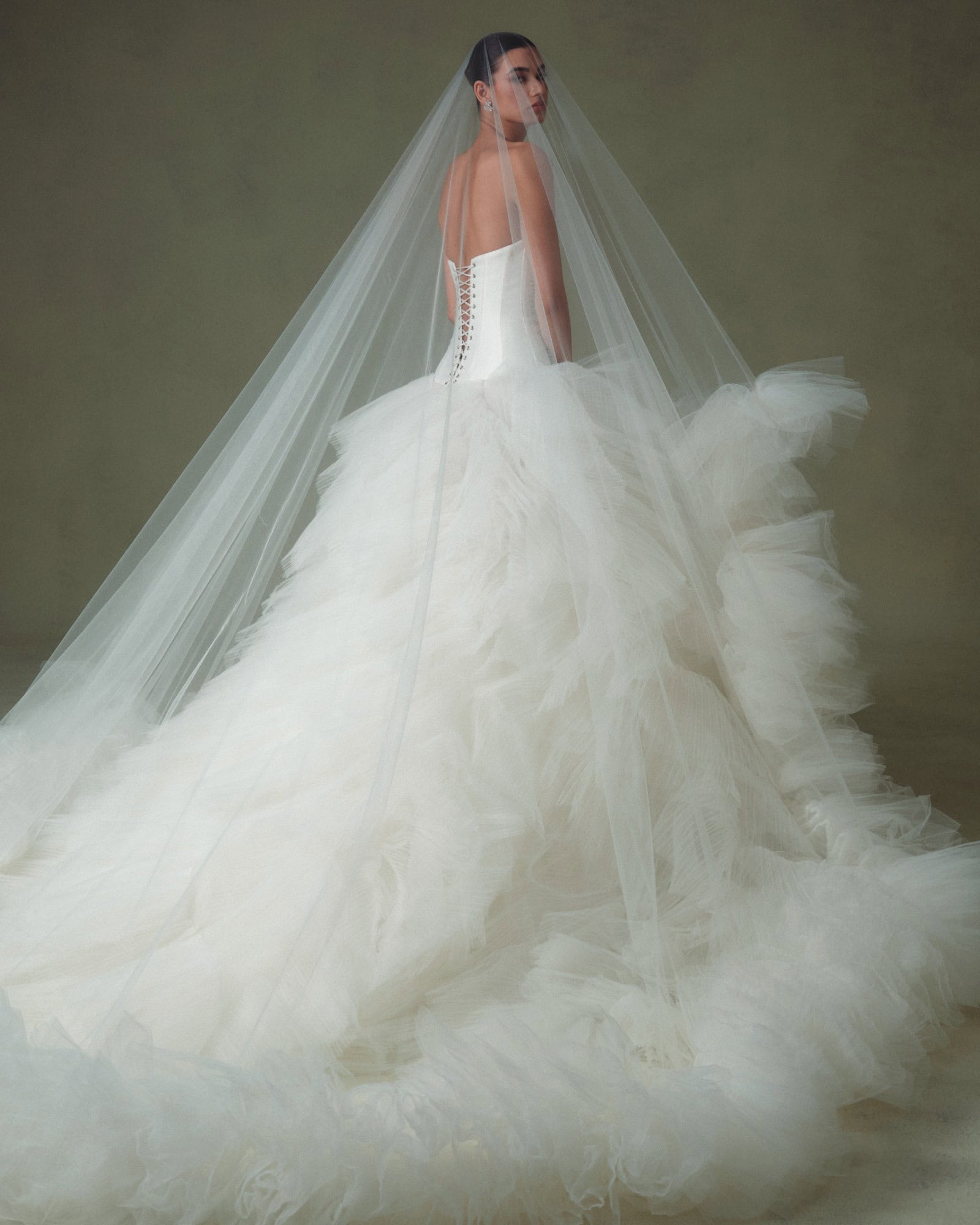
There’s lace, and then there’s Idan Cohen’s lace. The Israeli-born bridal designer, celebrated for his meticulous — some might even say obsessive — attention to detail gently lifts the delicate sleeve of a translucent gown to demonstrate the difference. “Okay, this lace is classic,” he says. It’s floral, but with a modern edge, its sinuous, rounded outlines suggesting, rather than representing, flowers. “But then,” he points out, “I cut it and create this 3-D element.” Look closely, and you see that some of the petals have been subtly snipped to rise up from the fabric. The effect is magical and must be even more so when the gown is in motion, a fluttering, slightly surreal garden.

The magic of Cohen’s creations has won him a celebrity following: He’s dressed Paula Abdul, Jennifer Lopez, Laverne Cox, Mariah Carey, and Kelly Osborne, among others. Nicki Minaj appeared in his glittering, gem-encrusted bodysuit (yes, he ventures beyond bridal) on the July 2015 cover of Cosmopolitan, and he recently designed the white minidress that Demi Lovato wore at her wedding after-party.
“I design for strong women,” he says, a group that, in his mind, seems to comprise most of the gender. “I know the power of women because I grew up next to it,” he explains. He’s referring, specifically, to his grandmothers, whom he calls “the most courageous women I’ve met in my life. They came to Israel from Morocco and Tunisia speaking no Hebrew, in the middle of the night, with their kids, and with nothing to live in except tents, to create this beautiful family.” In fact, it was one of his grandmothers who taught him to stitch when he was five, and together they’d create clothes for his cousins’ dolls out of fabric, socks, shoelaces, buttons. That was his earliest introduction to fashion, but by the time he was ten, he knew that his future was in design.

Cohen grew up immersed in fashion. His family founded the luxury denim brand Crocker Jeans, and when he was eight he learned how to judge a fabric by the way it felt in his hands. At 15, he was introduced to Ricky Ben Ari, who’d been Yves Saint Laurent’s right hand in Paris. Ben Ari, then 89, taught him not just how to create fashion sketches but also how to look at a dress to understand its structure and flow. Cohen treasured his time with her and followed her advice to study fashion at the Istituto Marangoni in London, a decision that’s informed his work ever since. He was especially struck by the way London designers embraced the classics but with a modern twist — which is exactly how he describes his own designs.
As an example, he points out a short bridal dress he designed that was inspired by crinolines — the structured petticoats popular in the 19th century. It’s unlikely that Queen Victoria, famous for her crinolines, would have chosen the strapless minidress for her own nuptials (or any other occasion, for that matter), but she might well have admired its extravagant pearl beading. In fact, the dress, with its faultless geometric boning, is also an example of Cohen’s pride in technique. “All my construction will be without mistakes,” he says, noting that his dresses are so carefully constructed you could happily wear them inside out. When Cohen talks about his own careful workmanship, it comes off less as braggadocio than a simple statement of fact, as when he says, “My corsets are flawless,” attributing their perfection not just to his own abilities but also to those of his team. (He’s not referring to underthings, by the way, but to the elegant corsets he incorporates into many of his gowns.)

Mastery of technique has been at the heart of Cohen’s designs since he opened his first atelier in Tel Aviv in 2012. Initially, he chose to design for the bridal market because, he says, “in Israel, if you want to do couture, the main market is bridal.” But he soon fell in love with that market. “How can you not?” he asks. “You’re dressing a woman for a day she was dreaming about all her life.” He feels blessed, he says, that he can “work on the happier side of life.”
Some of his own happiest moments — outside of his time spent designing, which he characterizes as pure joy — have been in the gardens he’s visited on his travels, and in fact, nature is one of his abiding influences. “When I go out into nature and I see beautiful flowers, beautiful trees,” he says, “it’s like my heart is a guitar and it starts to play.” His collection for fall 2026, which debuted in October 2025 at New York Fashion Week, offered a floral symphony of sorts, including beaded blooms dripping from a form-fitting bodice, three-dimensional floral lace defining a neckline, and a showstopping gown festooned with what looked like larger-than-life waterlilies.

Another major influence is royalty. “My favorite queen of all times,” he says, “is Elizabeth the First” — a fondness evident in the opulence that marks all of his work, especially his hand-beading. In 2013, a beader who worked with Chanel, Givenchy, Yves Saint Laurent, and other prominent fashion houses introduced him to the centuries-old techniques that are evident in his own intricate beadwork.
Cohen’s attention to detail, combined with his ability to add an inspired modern touch to classic silhouettes, made him one of Israel’s most in-demand designers, but he longed to scale more distant fashion peaks. Specifically, he wanted to fulfill a long-held dream to live and work in the U.S. In November 2022 he established a partnership with American backers and moved to Los Angeles. Five months later, he opened his current atelier in Lambertville, New Jersey, a town that’s famous for attracting artists and other creatives. In 2024, to celebrate this new beginning, he rebranded his company, originally known as Idan Cohen, to House of Idan and introduced two separate lines, Idan Atelier, characterized by extravagant fabrications and detailed handiwork, and Idan, less pricey but nonetheless graced with the distinctive touches that mark all of his creations. Among the high-end retailers now carrying his designs is New York City’s venerable Bergdorf Goodman.


Explore more: