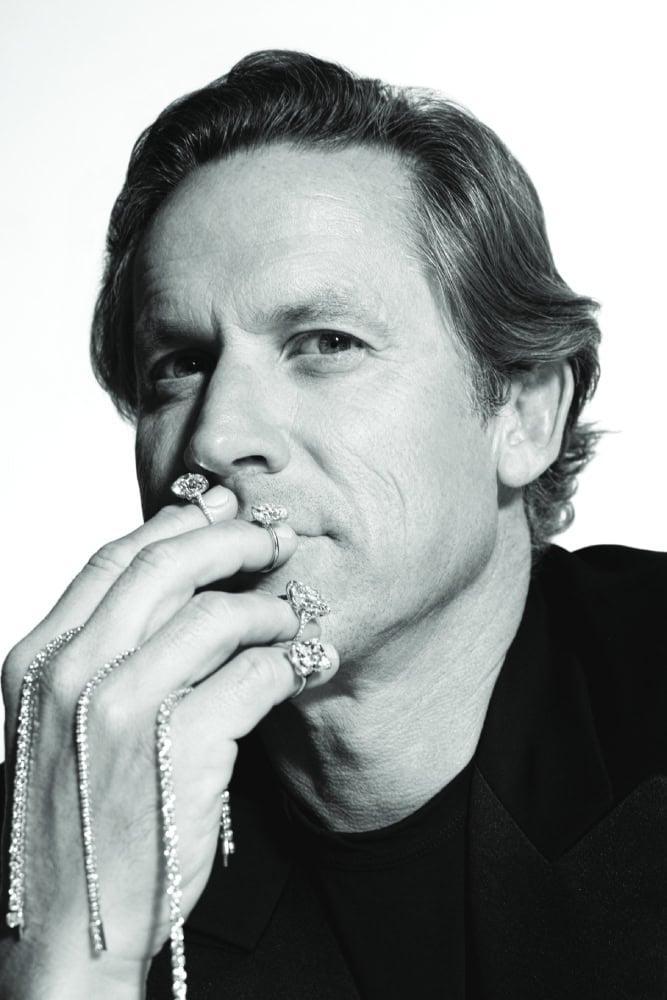
Though Jean Dousset is the great-great-grandson of Louis Cartier, he’s quick to clarify that he didn’t grow up surrounded by glass cases and red boxes. Cartier had been sold out of the family by then. “I wasn’t born crawling around Cartier stores,” he says. Instead, Jean came to jewelry on his own timeline, through years spent inside the most storied maisons, including Chaumet, Boucheron, and Van Cleef & Arpels. “I learned from the best,” he says. Forging his own path wasn’t immediate, though. “It took a long time before I felt the courage to become a jewelry designer of my own,” he admits. Once he did, Jean’s strong aesthetic point of view paired with the same level of craftsmanship, customer experience, and artisanship that shaped his famous ancestor’s era.
Even with a prestigious foundation, Jean felt constrained by traditional diamonds. Scarcity and price-driven limitations resulted in a narrow reach for fine jewelry. “The actual number of people that could see, enjoy, and own that jewelry was very few,” he says. His goal? To make diamonds more accessible. “Natural diamonds forced me to keep it small,” he explains.
That changed when Jean encountered lab-grown diamonds — the innovation that would redefine his brand and expand his creative freedom. The moment Jean first held a high-quality lab-grown diamond, cut by artisans from the traditional industry and held to the same standards as mined stones, everything changed. “That looks like the diamond that I’ve been looking at for 30 years,” he recalls. “I was instantly sold. I was like, ‘Wow, this is it.’”

In 2023, Dousset became one of the first luxury designers to commit entirely to lab-grown diamonds. The shift, he says, expanded his creative possibilities “a million times.” Free from the pricing hierarchies and extraction limitations of mined stones, “It allows me to create and imagine jewelry without the constraint of what the price is going to be — for me and for you.”

Customers encountering lab diamonds for the first time often have two questions. Is it real? Yes. Can even an experienced eye tell the difference? No. To skeptics, Jean simply says: “Seeing is believing.”

Jean is confident his great-great-grandfather — a “bold, innovative, curious person,” he says — would have embraced the innovation. He cites a workshop note attributed to Louis Cartier: “What nature dares not to do, the jeweler must imagine.” As Jean puts it, “That’s exactly what we’re doing with lab-grown diamonds. We’re transcending nature.”
Explore more: